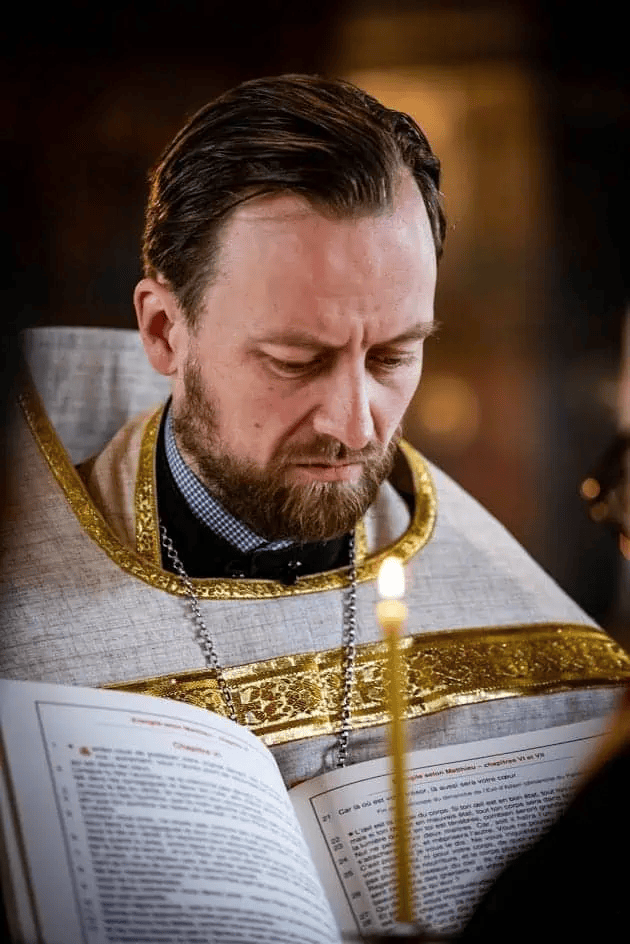
Archimandrite Johannes Johansen and the Transformation of St Nicholas Parish
The period from the coronavirus pandemic and the dissolution of the Paris Exarchate in 2018 cannot be understood without the longer history that preceded it. Archimandrite Johannes Johansen (Rolf Johansen) had by then already served for several decades as the central priest of St Nicholas parish (Hellige Nikolai menighet) in Oslo, the oldest continuous Orthodox community in the country. Through his ministry a large number of Norwegian converts first encountered Orthodox Christianity. At the same time, the transition from his predecessor to his own leadership marked one of the deepest internal shifts the Norwegian Orthodox milieu has experienced.
The contrast between Archimandrite Therapon (Johannes Hümmerich, 1900–1988) and Father Johannes could hardly have been greater. Therapon was a cultivated European intellectual who had moved through socialist circles, depth psychology, the Paris emigration and the theological world of Saint-Serge. In Oslo he lived simply, ate at the Salvation Army soup kitchen, moved freely among the poor, artists and intellectuals, and exercised a pastoral style marked by openness, humour and personal presence. Many early Norwegian converts were formed under this influence.
When Therapon died on 3 June 1988, the parish stood without a resident priest. Therapon had earlier given his recommendation for Johannes’ ordination, yet in his will he requested that Johannes should not officiate at the funeral. The funeral took place from the Greek church and was conducted by Swedish priests. Johannes and his supporters were present, but without creating public disorder. The funeral therefore stands in striking contrast to the later funeral of Metropolitan Pavlos in Stockholm in 2022, where an explicit request that Metropolitan Cleopas should not participate was disregarded and open conflict followed.
The pastoral transition after Therapon’s death proved difficult for many. Johannes brought a more structured, disciplined and ascetic style of leadership. The open, almost bohemian atmosphere of the Therapon years gave way to a clearer emphasis on order and hierarchical authority. A significant number of the early Norwegian converts gradually withdrew. Over time the parish became more strongly characterised by its immigrant membership.
In the historical overview on the parish’s own website, Father Johannes himself states that the following clergy were ordained within the framework of St Nicholas parish: the deacons Serafim, Irakli Tsakadze and Urban Widetun, and the priests Poul Sebbelov, Bengt Hagström, Olav Lerseth, Christoforos Schuff and Theodor Svane. Of these eight, a majority later left the structure associated with the parish under Johannes. Some transferred to other jurisdictions, one was formally defrocked, and several now serve outside the Serbian milieu in Norway. This pattern underlines both the parish’s role as a place of recruitment and formation for Norwegian-connected clergy, and the fragmentation that characterised the Orthodox landscape in Norway after 2018.
The deeper tensions surrounding Father Johannes came fully into the open in 2018. Archbishop Jean suspended him twice – in February and May – for manifest and repeated disobedience, for rejecting the advice of the Disciplinary Commission, and for actions described as destructive of the unity of the Church. Johannes and the parish council closed the door to the appointed dean, Protopresbyter Angel Velitchkov. They claimed that St Nicholas parish should control all Orthodox communities in Norway as a single parish under themselves, and refused to concelebrate with Father Olav Lerseth and Father Theodor Svane. Johannes also publicly threatened critics with police reports. The parish council was formally excommunicated.
In the same period Jean travelled to Constantinople in an attempt to have Johannes removed. Instead of obtaining a decision concerning the priest, he learned that the Paris Exarchate itself had been dissolved. In the realignments that followed, St Nicholas parish under Archimandrite Johannes entered the Serbian Orthodox Church. Contemporary accounts indicate that this transfer took place without a publicly known dimissorial letter from the previous jurisdiction. The absence of such a letter has been noted by several observers as a serious canonical irregularity. The parish, however, remained loyal to its priest. The conflict with the former hierarchy was never fully resolved, and the community has since occupied a more independent and less clearly defined position within the wider Orthodox landscape in Norway.
Father Johannes continued as priest of St Nicholas parish after the transfer to the Serbian Church. The parish remained his permanent place of service. In July 2024 he was mentioned in connection with a priestly ordination within the Serbian structures in Norway, confirming that he still held recognised standing.
The long ministry of Archimandrite Johannes Johansen illustrates both continuity and rupture. He provided decades of stable liturgical life in the oldest Orthodox parish in the country and formed several generations of clergy and converts. At the same time, the sharp contrast with Therapon’s style, the unresolved canonical questions surrounding the 2018–2019 transition, the closed doors and the open power struggle with the archbishop left lasting marks on the Norwegian Orthodox environment. Any account of the period must therefore treat him not as a peripheral figure, but as one of the central actors whose decisions and relationships helped shape the fragmented landscape that followed.
Hellige Hallvard Oslo and Mariabebudelse
The Bergen Archdiocese of Orthodox Churches of Russian Tradition in Western Europe, commonly known as the Paris Exarchate, was established in the interwar period to serve the large community of Russian Orthodox refugees who had fled the Bolshevik Revolution and the subsequent civil war. Centred on the Cathedral of St Alexander Nevsky on Rue Daru in Paris, it developed into one of the most significant centres of Russian Orthodoxy in the West. For much of its history it stood under the omophorion of the Ecumenical Patriarchate of Constantinople, while preserving the liturgical, theological and cultural traditions of the Russian Church.
The Exarchate played a formative role in the intellectual and spiritual life of the Russian diaspora. It was closely associated with the St Sergius Institute and with figures who shaped twentieth-century Orthodox thought in the West. Over time it also became a home for non-Russian communities and for Western converts seeking an Orthodox church life outside the major national jurisdictions.
In November 2018 the Holy Synod of the Ecumenical Patriarchate dissolved the Exarchate and directed its parishes to place themselves under the local metropolitanates of the Ecumenical Throne. A substantial majority of the clergy and parishes, led by the then Archbishop Jean (Renneteau), declined to accept this decision. In 2019 they were received into the Moscow Patriarchate as the Archdiocese of Orthodox Churches of Russian Tradition in Western Europe, while retaining their own internal structures and identity. The Archdiocese continues under Metropolitan Jean of Dubna, with its centre still in Paris.
In Norway the former Exarchate’s legacy is visible in the Norwegian-language parishes of St Hallvard in Oslo and the Annunciation in Bergen, both of which remained within this tradition after the jurisdictional realignments of 2018–2019.
Theodor Svane and the Parish of the Annunciation of the Holy Virgin Mary in Bergen
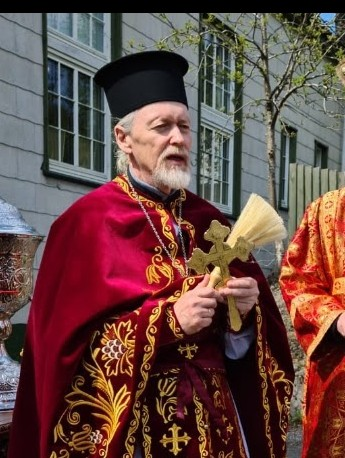
Theodor Svane (born Tor Vegard Svane) is an archpriest of the Archdiocese of Orthodox Churches of Russian Tradition in Western Europe and the founding and serving priest of the Parish of the Annunciation of the Holy Virgin Mary (Hellige Jomfru Marias Bebudelse) in Laksevåg, Bergen.
His path into Orthodoxy and the subsequent establishment of a Norwegian-language parish in western Norway form one of the clearer examples of convert-led mission work outside the major immigrant jurisdictions.
Early path and formation
Svane came from a western Norwegian Christian background. He first encountered Orthodoxy through the Bergen branch of St Nicholas parish (Hellige Nikolai menighet) under Archimandrite Johannes Johansen. The parish presented him as a candidate for ordination to Archbishop Gabriel of the then Paris Exarchate. With the support of both the central St Nicholas parish in Oslo and the local Bergen group, he was accepted for theological studies at St Vladimir’s Orthodox Theological Seminary in New York.
He was ordained to the priesthood on 14 January 2015 in the Cathedral of St Alexander Nevsky in Paris by Archbishop Job of Telmessos. After completing his studies he served for two years as an assistant priest at St Seraphim of Sarov Cathedral in Santa Rosa, California, within the Orthodox Church in America. During this period he also came into contact with experienced Orthodox military chaplains.
In June 2017 Svane and his family returned to Norway. In August of the same year he was appointed Norway’s first Orthodox military chaplain, serving with the Royal Norwegian Navy. The appointment reflected both the increasing religious diversity within the armed forces and the formal opening of the chaplaincy to non-Lutheran clergy.
Establishment of the parish
The Parish of the Annunciation has roots going back to the 1990s, when a small Orthodox presence already existed in the Bergen area under the wider umbrella of St Nicholas. It was formally established as a parish in 2018 by Archbishop Jean after Svane’s return. The community belongs to the Archdiocese of Orthodox Churches of Russian Tradition in Western Europe under Metropolitan Jean of Dubna — the continuation of the former Paris Exarchate.
From the beginning the parish has emphasised the use of Norwegian as the primary liturgical language, while remaining open to English and to the presence of Orthodox Christians from many national backgrounds. The core of the community has consistently been Norwegian converts, supplemented by families from Greece, the Middle East, the Baltic countries, Romania, Russia, Ukraine and elsewhere. Regular Sunday attendance has grown from a small handful of families to an average of thirty to fifty persons, with larger numbers at the great feasts. The parish is notably young; few members are over the age of fifty, and there are many children and students.
Acquisition of a church building
For several years the community rented space, first in a Lutheran parish hall and later in the former prayer house Betania in Laksevåg. In 2024 the parish succeeded in purchasing the entire five-storey building at Kringsjåveien 28. The acquisition was made possible by an international fundraising campaign that raised nearly 300,000 euros, including interest-free loans. Ownership was taken on 15 December 2024, the feast of St Tryphon, apostle to Norway.
The building contains a student dormitory for ten students as well as office space. The former meeting hall is being converted into a permanent Orthodox church. Plans for the interior explicitly seek to unite classical Orthodox liturgical forms with elements of traditional Norwegian church architecture and folk art — stave-church construction, wood carving and rosemaling. Matushka Hanne Svane, an icon painter currently completing a doctoral thesis in traditional arts at the King’s Foundation School of Traditional Arts in London, has played a central role in the design of the iconostasis and the overall aesthetic vision.
A further fundraising campaign was launched in 2025 with the goal of raising 1.5 million Norwegian kroner for the completion of the iconostasis, liturgical furnishings and general renovation.
Public presence and teaching
Father Theodor has been a regular contributor to the Christian newspaper Dagen, writing on Orthodox theology, the relationship between Orthodoxy and Norwegian culture, and questions of suffering, tradition and modernity. He and Matushka Hanne have also appeared in extended interviews, including for Ancient Faith Radio, discussing the possibility of a “Norse Orthodoxy” — that is, an Orthodox presence that is fully canonical yet culturally rooted in the Scandinavian landscape and history.
The parish has organised summer camps and other formative activities, and it maintains an active catechumenate. Its combination of Norwegian language, convert leadership, military chaplaincy and deliberate engagement with Norwegian artistic traditions has made it one of the more visible examples of contemporary Orthodox mission among ethnic Norwegians.
Jurisdictional context
The parish stands outside the Moscow Patriarchate. After the dissolution of the Paris Exarchate in 2018 it followed Metropolitan Jean into the Archdiocese of Orthodox Churches of Russian Tradition in Western Europe. In this respect it shares the same jurisdictional line as St Hallvard parish in Oslo under Father Olav Lerseth. Both communities represent a continuation of the older Paris tradition in Norway, distinct from the Greek Metropolis under Metropolitan Cleopas, the Serbian structures under Metropolitan Dositej, and the parishes of the Moscow Patriarchate.
Hellige Hallvard Orthodox Parish
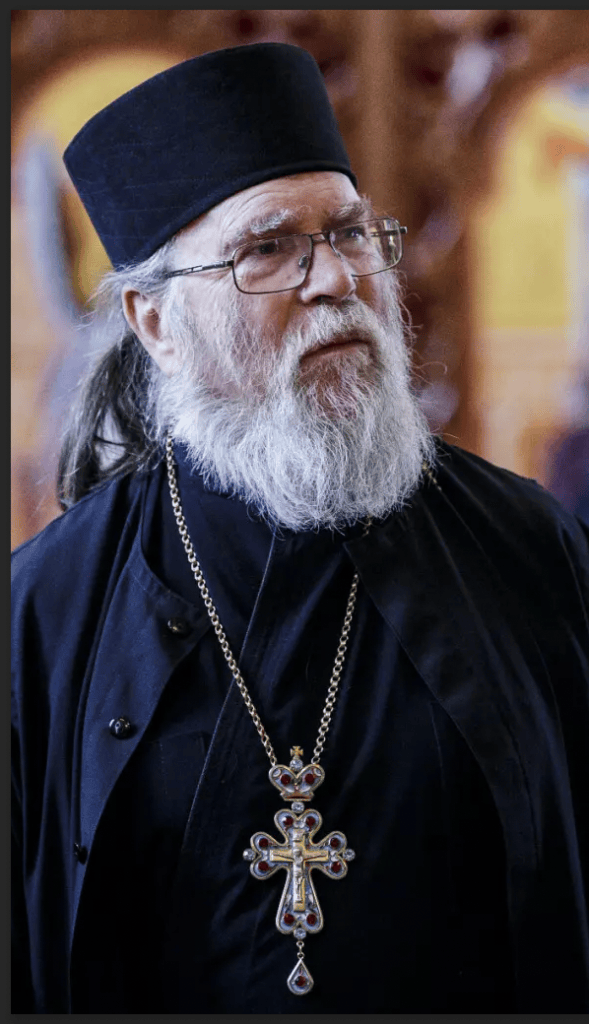
Hellige Hallvard Orthodox parish was established as a mission community (kirkeforening) by Archbishop Gabriel of the Archdiocese of Orthodox Churches of Russian Tradition in Western Europe in January 2012. From the outset it was placed directly under the Archbishop rather than under an existing parish. It was raised to the status of a full parish by Archbishop Jean in 2016, with Father Olav Lerseth appointed as its permanent priest.
The parish was conceived from the beginning as a Norwegian-language community intended primarily for Norwegian converts. All services are conducted in Norwegian. This deliberate linguistic and cultural orientation has distinguished it from the majority of Orthodox parishes in Norway, which have historically been organised around specific immigrant communities and their languages.
Father Olav Lerseth (Ole Petter Lerseth) has been the parish priest throughout its existence. He had earlier been connected with the Norwegian Orthodox Church environment of the 1990s and was later ordained within the established Orthodox structure under Archbishop Gabriel in 2008. The deacon of the parish is Father Kristoffer Ek, and the cantor is Mari Lerseth.
Early years and successive locations
In its first years the community’s activity was linked to Østfold. Services were held first in Moss and later in Fredrikstad. The priest’s family would transport the altar table and iconostasis for each occasion. As more people began to come from Oslo, the work gradually shifted to the capital. For a period the parish used premises in Korsvoll bedehus, where the liturgical equipment still had to be set up and taken down for every service. The family later built a small chapel on their own property in Korsvollbakken, which for the first time gave the community a permanent, if modest, church space. When attendance reached around twenty persons the room became full.
Since October 2020 the parish has leased Kjelsås bedehus (Myrerveien 4) from Normisjon on a ten-year agreement. The former prayer house has been furnished as an Orthodox church with a complete iconostasis. Divine Liturgy is celebrated every Sunday at 11.00, followed by coffee and fellowship. Vespers are held regularly on Wednesdays.
Jurisdictional continuity
Hellige Hallvard belongs to the Archdiocese of Orthodox Churches of Russian Tradition in Western Europe, the continuation of the former Paris Exarchate (Rue Daru). After the Ecumenical Patriarchate dissolved the Exarchate in November 2018 and sought to place its parishes under the local metropolitanates — including the Greek Metropolis of Sweden and All Scandinavia under Metropolitan Cleopas — Hellige Hallvard remained under Metropolitan Jean of Dubna. It therefore stands outside the Moscow Patriarchate while retaining its roots in the Russian liturgical tradition.
This jurisdictional choice has had lasting significance. In the years following the Russian invasion of Ukraine in 2022, the parish’s independence from the Moscow Patriarchate has been an important factor for some of those who have sought a Norwegian-language Orthodox community.
Character and place in the wider landscape
Hellige Hallvard remains a small parish. Its consistent use of Norwegian, its convert-oriented profile, and its independence from the major immigrant jurisdictions have made it a natural point of reference for Norwegians seeking an Orthodox church life that is not organised primarily around an ethnic community. In this respect it stands alongside the Parish of the Annunciation in Bergen under Father Theodor Svane as one of the clearest examples of deliberate Norwegian-language Orthodox mission work in the country.
The parish’s history also intersects with that of Roger Andreas Robberstad. Robberstad was for a period a lay member of Hellige Hallvard. He formally withdrew on 24 February 2022, citing the wider ecclesiastical questions raised by the war in Ukraine and his own earlier connection with Ukrainian Orthodox structures. The subsequent correspondence and complaint to Metropolitan Jean form part of the documented tensions that arose within and around the parish during and after the Covid period.
f. Johannes:
photo; ?
f.Olav
(Photo:?)
f.Theodor:
Photo NKR