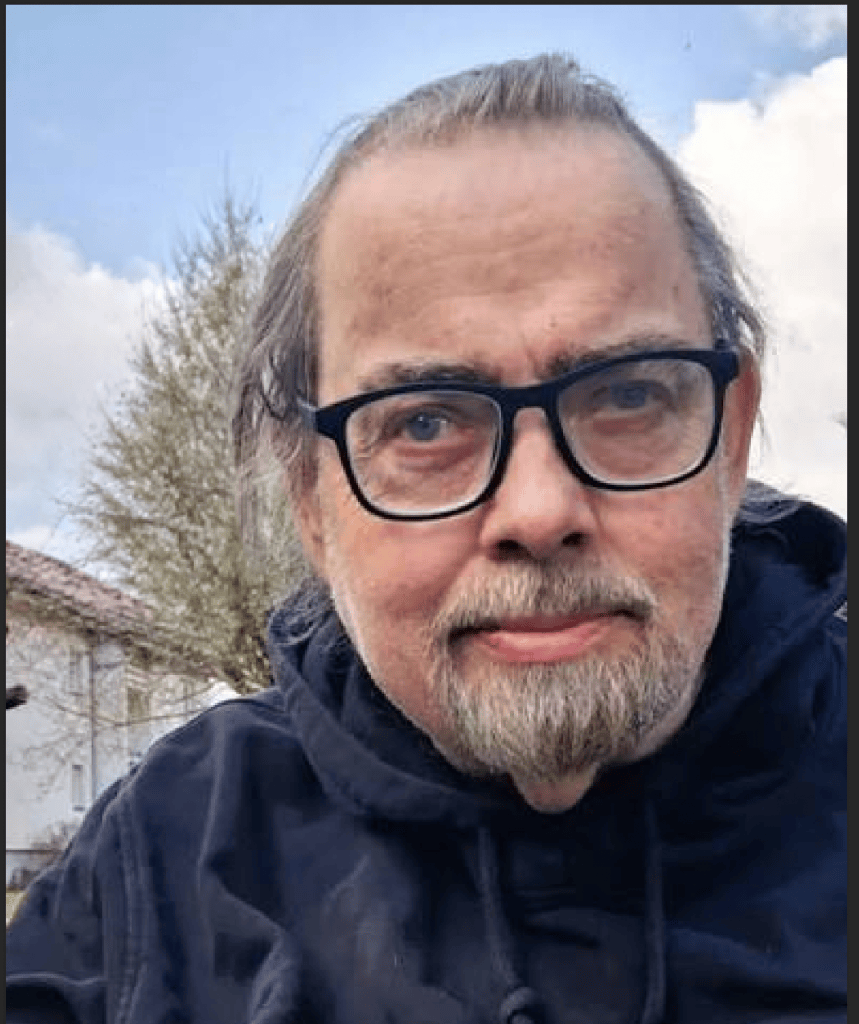
Roger Andreas Robberstad – Between Ordination, Rupture and Belonging
Roger Andreas Robberstad’s ecclesiastical history is difficult to place within any single, simple category. It passes through church environments outside the established Orthodox patriarchates, an attempt to create a Norwegian-language Orthodox church, a later Ukrainian ordination, serious illness, many years without a functioning ecclesiastical status, a return to parish life as an ordinary member, and finally his involvement in Ukrainian Orthodox activity in Norway.
The story includes substantial misjudgements and conflicts. At the same time, it illustrates a broader issue in Norwegian Orthodox history: how Norwegian converts could find—or fail to find—a place within an Orthodox Church that in Norway was for many years organised largely along national, linguistic and jurisdictional lines.
From St Nikolai to the Search for a Norwegian Church Environment
Robberstad himself recounts that his first encounter with Orthodox Christianity came when he was only eleven years old. He found his way to St Nikolai parish in Oslo and met Father Therapon, who made a lasting impression on him. Later he began attending the parish more regularly.
In his much later account to Metropolitan Jean, Robberstad describes his relationship with the parish environment as becoming increasingly difficult. He refers in particular to the conflicts surrounding Father Johannes and to the treatment of Therapon towards the end of the latter’s life. Eventually, he concluded that St Nicholas could not become his permanent ecclesiastical home.
This should also be understood against the situation facing Norwegian converts in the 1970s and 1980s. Orthodox parishes in Norway were to a considerable degree organised around different immigrant communities, languages and national churches. There were few established structures for Norwegians seeking to live an Orthodox church life in their own language.
Robberstad and other Norwegian converts therefore also looked towards Sweden, including to Father Christopher Klasson. The distances made such an arrangement difficult to maintain over time. The search consequently continued for a church environment in which Norwegian language and cultural belonging could be combined with Orthodox faith and liturgy.
The First Ordinations
Robberstad eventually became involved in an Old Catholic and Apostolic Episcopal environment. According to his own account and later sources, he was ordained deacon on 26 November 1986 and priest on 14 December of the same year by Dag Gissur Værnes Giverholt, who used the ecclesiastical name Father Filippus.
Robberstad was later consecrated bishop by two foreign bishops. The sources differ somewhat regarding the exact date of this consecration. During this period he used the name Stefan Georgius and the title «Orthodox Bishop of Selja.»
A distinction must be made between legal status under Norwegian law and ecclesiastical status within Orthodoxy. These ordinations and the episcopal consecration did not mean that Robberstad was recognised as an Orthodox bishop by the established Orthodox patriarchates. The church environment to which he belonged stood outside their ecclesiastical communion.
This did not, however, prevent the organisation from being established as a legally recognised religious community in Norway.
The Norwegian Orthodox Church
In the early 1990s the community was organised as Den norske ortodokse kirke – the Norwegian Orthodox Church. The body was registered with the Norwegian authorities and received public funding on the same basis as other registered religious and life-stance communities. By the end of the 1990s, sources give a figure of approximately 150 registered members.
That number primarily reflects the formal membership used for registration and public funding; it cannot automatically be taken as a measure of regular church attendance.
The church worked with Orthodox liturgy in the Norwegian language and used, among other things, translations and adaptations based on Swedish and Danish texts. Services were held in Oslo, including in a chapel at Vår Frelsers gravlund.
One of its important collaborators was the composer and professor Trond Kverno, who contributed considerable liturgical and church-musical expertise.
The Norwegian Orthodox Church therefore had a real organisational existence. It had members, services, clergy and official registration. Its fundamental problem lay elsewhere: it was not recognised by the established Orthodox churches.
In this context, the term «uncanonical» does not mean illegal under Norwegian law. It describes the fact that the church body and its ordinations were not incorporated into or recognised by the established Orthodox patriarchates and their episcopal structures.
The church subsequently attempted to establish various forms of external affiliation. In the late 1990s a connection was made with Christ Catholic Church International, while contacts were also explored with the Coptic Orthodox Church. These efforts contributed to internal disagreements. Some wished to pursue such directions, while others did not.
These attempts reveal both the ambition and the weakness of the project: the desire for a Norwegian Orthodox church was genuine, but its ecclesiastical foundation remained unstable.
The Connection with Ole Petter Lerseth
One person from this period who would later become important in Robberstad’s story was Ole Petter Lerseth, later known as Father Olav Lerseth.
In private correspondence from 2022, Robberstad stated that Lerseth had served together with him in the Norwegian Orthodox Church and had received ordination at his hands. The claim was later repeated by several former members of St Hallvard parish in a complaint addressed to Metropolitan Jean.
A private photograph was attached to the complaint and identified by the complainants as showing Robberstad and Lerseth concelebrating in the Norwegian Orthodox Church. The material therefore provides several indications of a connection between Lerseth and this environment. His precise ecclesiastical status during that period, however, has not yet been fully documented through independent contemporary archival sources.
Lerseth’s later priestly ministry must in any case be clearly distinguished from this earlier phase. He was subsequently ordained within the established Orthodox ecclesiastical structure under Archbishop Gabriel in 2008.
The earlier connection between Robberstad and Lerseth would acquire importance decades later, in a very different context.
Dissolution in 2000
When the Moscow Patriarchate established a more permanent presence in Oslo around the turn of the millennium, the situation changed. In his later account to Metropolitan Jean, Robberstad writes that the young Father Kliment wanted to work also among Norwegian Orthodox Christians. Robberstad presents this as the point at which he regarded the task of the Norwegian Orthodox Church as having come to an end.
The church was dissolved as an independent structure on 17 May 2000.
It would, however, be too simple to explain the dissolution solely by the establishment of the Moscow Patriarchate’s activity. Internal conflicts, problems of canonical recognition and the various attempts to secure an external ecclesiastical affiliation must also be taken into account. Several factors may have operated simultaneously.
One further detail belongs to the closing phase of the Norwegian Orthodox Church and the transition that followed. When the Moscow Patriarchate established a more permanent presence in Oslo around the turn of the millennium, Robberstad played a practical role in the arrangement by which the former funeral chapel at Vår Frelsers gravlund was made available to the newly formed Russian parish. The same building that had earlier been used by the Norwegian Orthodox Church was transferred to Hellige Olga menighet. It was consecrated as an Orthodox church in 2004 by the then Metropolitan Kirill of Smolensk and Kaliningrad, who later became Patriarch of Moscow. In this way Robberstad’s earlier organisational efforts for a Norwegian Orthodox structure contributed, indirectly and in a later context, to the establishment of the principal Russian Orthodox church in the Norwegian capital. The arrangement marked both the formal end of the independent Norwegian body and the beginning of a new chapter for the Moscow Patriarchate’s presence in Oslo.
After the dissolution, Robberstad moved to Sweden.
Stockholm and Michel Laroche
In Stockholm, Robberstad came into contact with Svenska Ortodoxa Kyrkan, the Swedish Orthodox Church. This environment itself had a complicated ecclesiastical status. Among its priests were Salvatore Cajozzo and Ioan Ruja.
In May 2003 Metropolitan Michel Laroche came to Stockholm.
According to Robberstad’s own account, the ordinations took place on 24 and 25 May 2003. On the Saturday he took monastic vows and was ordained deacon. On the Sunday he was ordained priest by Laroche.
At the time, Laroche was connected with the Kyiv Patriarchate under Patriarch Filaret. Robberstad had therefore received a new priestly ordination within a Ukrainian ecclesiastical structure.
This did not resolve the question of his status in relation to the other Orthodox churches. At that time the Kyiv Patriarchate was not recognised by the other canonical Orthodox churches. The Stockholm ordination therefore did not automatically give Robberstad access to priestly ministry in an established Orthodox parish in Norway.
Shortly afterwards he was seriously injured in an accident following a liturgy. In his letter to Jean, he states that he spent approximately six months in a Stockholm hospital, including three weeks in a coma. The injuries had lasting consequences.
In the same letter, Robberstad emphasises that he received no visits from his fellow clergy during his hospitalisation. Among those who did travel from Norway to see him were Olav Lerseth and his wife Mari. This shows that the connection between Robberstad and Lerseth continued after the Norwegian Orthodox Church had been dissolved.
Following his hospital stay, Robberstad returned to Norway. Several other priests from the Swedish environment later found a place under the Romanian Patriarchate. Robberstad did not.
He now had monastic vows and a priestly ordination from Michel Laroche, but no bishop in Norway under whom he could actually exercise priestly ministry.
Another Life: Art
In the years that followed, Robberstad was for practical purposes without an active clerical function. This period should not, however, be treated as an empty interval between two ecclesiastical phases. He established an independent practice in visual art and photography.
He completed studies in visual art, including at NISS and Prosjektskolen, and later worked with photography and other visual media. His artistic career developed into a public professional activity that received some clear institutional recognition.
One of his works was acquired for the City of Oslo Art Collection following an exhibition at Oslo City Hall. He also exhibited at the Olsok Exhibition at Stiklestad, including in 2022 with the work The Deposition of Christ from the Cross. The work was connected to Ukraine, the war and the experience of refugees.
As an artist, he therefore received a measure of institutional recognition, notably through the acquisition by the City of Oslo art collection and his exhibition participation at Stiklestad. He had a documented professional artistic practice, although he did not belong to the top national or international tier of Norwegian artists.
The artistic period consequently forms an independent part of Robberstad’s biography. For a number of years, he maintained a public and professional activity in which his former clerical identity was not the central element.
Return to Orthodox Parish Life
In time, Robberstad returned to regular church life. He became involved in the community around Korsvoll and St Hallvard Orthodox parish in Oslo and eventually became a member there.
Olav Lerseth was now the parish priest.
Robberstad did not function as a priest. He participated as a parish member and carried out the tasks assigned to him within the parish. This is important for the later conflict, because his previous ordinations do not appear to have served as the basis for any regular priestly function at St Hallvard.
The question of his ecclesiastical status had nevertheless not disappeared.
The Letter to Metropolitan Jean
In 2018 Robberstad wrote a lengthy account to Metropolitan Jean. The letter was later sent again in 2020.
The document is the most coherent surviving first-person account of his ecclesiastical history. Robberstad discusses the Old Catholic period, the episcopal consecration, the Norwegian Orthodox Church, its dissolution in 2000, his connection with Michel Laroche, the Stockholm ordination, the accident and the years outside active church life.
Nor does he attempt to present this history as unproblematic. He writes about mistakes of his own and decisions that he later regretted.
The specific question he places before Jean concerns primarily his monastic vows.
If the Metropolitan considered the vows taken in 2003 still valid, Robberstad asked for permission to wear monastic clothing. If Jean did not regard the vows as valid, Robberstad asked to be tonsured again.
He was therefore asking the bishop to determine the matter.
This should be distinguished from a direct application to be recognised as a priest at St Hallvard. The letter contains his ordination history, but the explicit request concerns his monastic status.
A later complaint to Metropolitan Jean alleged that the letter had not been forwarded by Lerseth as it should have been. This is a serious allegation, but it has not been conclusively documented in the material currently available. We therefore do not know with certainty how, or whether, the matter was dealt with at episcopal level.
The Conflict at St Hallvard
During the Covid period, tensions gradually arose within St Hallvard parish.
A small group of believers met privately for the reading of the Hours, conversation and catechetical study. According to the group’s own later account, it consisted of five or six people and made use, among other things, of Swedish Orthodox catechetical material.
Lerseth regarded aspects of the activity as problematic and as a challenge to parish order. Robberstad and others in the group, on the other hand, maintained that the particular Hours in question could be read by laypeople without a priest.
Behind the individual incidents therefore lay a broader question concerning the boundary between the priest’s pastoral authority and lay initiative.
Relations deteriorated further.
On 24 February 2022, the same day that Russia launched its full-scale invasion of Ukraine, Robberstad formally withdrew from St Hallvard parish. He gave the parish’s ecclesiastical connection with Moscow as a decisive reason. His earlier connection with Michel Laroche and the Ukrainian ecclesiastical tradition thereby acquired renewed relevance.
During the spring of 2022, an extensive and at times highly acrimonious correspondence developed between Lerseth and several former members. By 27 April 2022 at the latest, the conflict is clearly documented in the surviving correspondence. By then the dispute concerned, among other matters, blocking people on Facebook, the replacement of locks, questions of access to the church premises, and disagreements over liturgical vestments and other objects. The surviving material indicates that the conflict had already been developing for some time, but it does not justify treating 27 April as the starting date of the correspondence.
Lerseth accused Robberstad and others of exceeding the limits of the lay role, of having problematic uncanonical backgrounds, and of engaging in activity that might develop into another uncanonical group. He also wrote that bishops with jurisdiction in Scandinavia had been informed.
Robberstad disputes several of these accounts of events. Among other things, he explains his understanding of the right of laypeople to read the Hours and his version of specific incidents within the church premises. He also reminds Lerseth of their shared history in the Norwegian Orthodox Church.
In the part of the correspondence that has survived, Robberstad’s replies are generally less confrontational in their wording than Lerseth’s longest response. This can be said of the texts currently available, but it is not a sufficient basis on which to judge the entire dispute. The material is incomplete, and we do not have access to Lerseth’s complete correspondence or the full ecclesiastical handling of the case.
In one reply Robberstad writes:
«I am not your enemy; I am simply an old friend trying to put things into words.»
Later he asks for the correspondence to cease:
«Stop now, leave me alone, I am finished and seriously ill. I want the remaining time to be peaceful. I pose no threat to you.»
The conflict also resulted in a formal approach to Metropolitan Jean by several former parish members. The complaint raised questions concerning, among other matters, parish governance, financial transparency, pastoral conduct, theological practice and Lerseth’s treatment of former members. It also included information concerning his earlier connection with the Norwegian Orthodox Church.
The allegations in the complaint must be treated for what they are: allegations made by one side in a conflict. At the same time, the document is an important primary source for understanding how the dispute was perceived by the group that left the parish.
Ukraine and Trondheim
In the spring of 2023 a Ukrainian Orthodox parish was organised in Trondheim. Jørgen Giorgio Bosoni played a central role in the organisational work, while Mykhailo Horyslavets became the priest serving the community.
Robberstad appears early in the formal organisational structure together with Bosoni, Horyslavets and others.
His function here differed from the role he had held in the Norwegian Orthodox Church during the 1990s. He did not present himself as the local bishop and did not establish a separate jurisdiction. The available material points primarily to an organisational and advisory role and to a function as a Norwegian point of contact.
An important document is the letter he sent to Archbishop Daniel Zelinsky on 31 July 2023.
In that letter, Robberstad himself refers to his priestly ordination by Michel Laroche in 2003, while at the same time stating that he is not under any bishop’s omophorion. He therefore does not present his own priestly status as settled.
Nor is his own status the main subject of the letter. Its principal concern is the situation surrounding Horyslavets and the difficulties that had arisen around the establishment of Ukrainian Orthodox activity in Norway.
By this point a jurisdictional conflict had developed around the new Ukrainian activity. Metropolitan Cleopas had objections to Horyslavets’ ministry and to the establishment of a Ukrainian ecclesiastical structure in Scandinavia. Private source information describes the conflict as considerably sharper than can presently be documented from publicly available sources. Such information should therefore not be presented as documented quotation unless the relevant correspondence itself becomes available.
From 2023 onward, Robberstad appears in the work surrounding Ukrainian ecclesiastical activity in Norway. He is present in the organisational structure together with Bosoni, Horyslavets and others, and the correspondence demonstrates that he also had direct contact with Ukrainian hierarchs.
In the letter to Daniel he describes his own ecclesiastical position without ambiguity: he refers to his ordination by Michel Laroche in 2003, but at the same time states that he is not under a bishop’s omophorion. The principal subject of the letter is not his own status but the position of Horyslavets and the establishment of Ukrainian ecclesiastical activity in Norway.
Within the new structure, Robberstad appears primarily to have had an organisational and advisory function, with particular importance as a Norwegian point of contact. His long experience with religious organisations, church jurisdictions and Norwegian institutional conditions provided knowledge that was relevant to a community attempting to establish itself in a new country.
Later photographs show him wearing a cassock and monastic clothing, with a priest’s cross, and on some occasions seated within the iconostasis. At the same time, it is the Ukrainian priests who appear as the liturgical celebrants. The available material therefore does not provide a basis for claiming that Robberstad had once again received regular priestly ministry.
His earlier ecclesiastical status remained complicated. The Laroche ordination, the monastic vows and the question of which ecclesiastical authority, if any, he belonged under had not been unambiguously resolved in the material currently available. What had changed was that this ambiguity no longer prevented him from holding a practical role in the work surrounding the Ukrainian Church.
Thus two parts of Robberstad’s history that had previously been separated came together. In 2003 he had been tonsured and ordained priest by Michel Laroche within the Kyiv Patriarchate. Twenty years later he was again working in a Ukrainian ecclesiastical context, this time in Norway. The difference was that he was no longer leading a jurisdiction of his own and did not present himself as a serving priest. His role was connected instead with organisation, liaison work and support for the Ukrainian clergy and parishes.Roger Andreas Robberstad – Between Ordination, Rupture and Belonging
Roger Andreas Robberstad’s ecclesiastical history is difficult to place within any single, simple category. It passes through church environments outside the established Orthodox patriarchates, an attempt to create a Norwegian-language Orthodox church, a later Ukrainian ordination, serious illness, many years without a functioning ecclesiastical status, a return to parish life as an ordinary member, and finally his involvement in Ukrainian Orthodox activity in Norway.
The story includes substantial misjudgements and conflicts. At the same time, it illustrates a broader issue in Norwegian Orthodox history: how Norwegian converts could find—or fail to find—a place within an Orthodox Church that in Norway was for many years organised largely along national, linguistic and jurisdictional lines.
From St Nikolai to the Search for a Norwegian Church Environment
Robberstad himself recounts that his first encounter with Orthodox Christianity came when he was only eleven years old. He found his way to St Nikolai parish in Oslo and met Father Therapon, who made a lasting impression on him. Later he began attending the parish more regularly.
In his much later account to Metropolitan Jean, Robberstad describes his relationship with the parish environment as becoming increasingly difficult. He refers in particular to the conflicts surrounding Father Johannes and to the treatment of Therapon towards the end of the latter’s life. Eventually, he concluded that St Nicholas could not become his permanent ecclesiastical home.
This should also be understood against the situation facing Norwegian converts in the 1970s and 1980s. Orthodox parishes in Norway were to a considerable degree organised around different immigrant communities, languages and national churches. There were few established structures for Norwegians seeking to live an Orthodox church life in their own language.
Robberstad and other Norwegian converts therefore also looked towards Sweden, including to Father Christopher Klasson. The distances made such an arrangement difficult to maintain over time. The search consequently continued for a church environment in which Norwegian language and cultural belonging could be combined with Orthodox faith and liturgy.
The First Ordinations
Robberstad eventually became involved in an Old Catholic and Apostolic Episcopal environment. According to his own account and later sources, he was ordained deacon on 26 November 1986 and priest on 14 December of the same year by Dag Gissur Værnes Giverholt, who used the ecclesiastical name Father Filippus.
Robberstad was later consecrated bishop by two foreign bishops. The sources differ somewhat regarding the exact date of this consecration. During this period he used the name Stefan Georgius and the title «Orthodox Bishop of Selja.»
A distinction must be made between legal status under Norwegian law and ecclesiastical status within Orthodoxy. These ordinations and the episcopal consecration did not mean that Robberstad was recognised as an Orthodox bishop by the established Orthodox patriarchates. The church environment to which he belonged stood outside their ecclesiastical communion.
This did not, however, prevent the organisation from being established as a legally recognised religious community in Norway.
The Norwegian Orthodox Church
In the early 1990s the community was organised as Den norske ortodokse kirke – the Norwegian Orthodox Church. The body was registered with the Norwegian authorities and received public funding on the same basis as other registered religious and life-stance communities. By the end of the 1990s, sources give a figure of approximately 150 registered members.
That number primarily reflects the formal membership used for registration and public funding; it cannot automatically be taken as a measure of regular church attendance.
The church worked with Orthodox liturgy in the Norwegian language and used, among other things, translations and adaptations based on Swedish and Danish texts. Services were held in Oslo, including in a chapel at Vår Frelsers gravlund.
One of its important collaborators was the composer and professor Trond Kverno, who contributed considerable liturgical and church-musical expertise.
The Norwegian Orthodox Church therefore had a real organisational existence. It had members, services, clergy and official registration. Its fundamental problem lay elsewhere: it was not recognised by the established Orthodox churches.
In this context, the term «uncanonical» does not mean illegal under Norwegian law. It describes the fact that the church body and its ordinations were not incorporated into or recognised by the established Orthodox patriarchates and their episcopal structures.
The church subsequently attempted to establish various forms of external affiliation. In the late 1990s a connection was made with Christ Catholic Church International, while contacts were also explored with the Coptic Orthodox Church. These efforts contributed to internal disagreements. Some wished to pursue such directions, while others did not.
These attempts reveal both the ambition and the weakness of the project: the desire for a Norwegian Orthodox church was genuine, but its ecclesiastical foundation remained unstable.
The Connection with Ole Petter Lerseth
One person from this period who would later become important in Robberstad’s story was Ole Petter Lerseth, later known as Father Olav Lerseth.
In private correspondence from 2022, Robberstad stated that Lerseth had served together with him in the Norwegian Orthodox Church and had received ordination at his hands. The claim was later repeated by several former members of St Hallvard parish in a complaint addressed to Metropolitan Jean.
A private photograph was attached to the complaint and identified by the complainants as showing Robberstad and Lerseth concelebrating in the Norwegian Orthodox Church. The material therefore provides several indications of a connection between Lerseth and this environment. His precise ecclesiastical status during that period, however, has not yet been fully documented through independent contemporary archival sources.
Lerseth’s later priestly ministry must in any case be clearly distinguished from this earlier phase. He was subsequently ordained within the established Orthodox ecclesiastical structure under Archbishop Gabriel in 2008.
The earlier connection between Robberstad and Lerseth would acquire importance decades later, in a very different context.
Dissolution in 2000
When the Moscow Patriarchate established a more permanent presence in Oslo around the turn of the millennium, the situation changed. In his later account to Metropolitan Jean, Robberstad writes that the young Father Kliment wanted to work also among Norwegian Orthodox Christians. Robberstad presents this as the point at which he regarded the task of the Norwegian Orthodox Church as having come to an end.
The church was dissolved as an independent structure on 17 May 2000.
It would, however, be too simple to explain the dissolution solely by the establishment of the Moscow Patriarchate’s activity. Internal conflicts, problems of canonical recognition and the various attempts to secure an external ecclesiastical affiliation must also be taken into account. Several factors may have operated simultaneously.
One further detail belongs to the closing phase of the Norwegian Orthodox Church and the transition that followed. When the Moscow Patriarchate established a more permanent presence in Oslo around the turn of the millennium, Robberstad played a practical role in the arrangement by which the former funeral chapel at Vår Frelsers gravlund was made available to the newly formed Russian parish. The same building that had earlier been used by the Norwegian Orthodox Church was transferred to Hellige Olga menighet. It was consecrated as an Orthodox church in 2004 by the then Metropolitan Kirill of Smolensk and Kaliningrad, who later became Patriarch of Moscow. In this way Robberstad’s earlier organisational efforts for a Norwegian Orthodox structure contributed, indirectly and in a later context, to the establishment of the principal Russian Orthodox church in the Norwegian capital. The arrangement marked both the formal end of the independent Norwegian body and the beginning of a new chapter for the Moscow Patriarchate’s presence in Oslo.
After the dissolution, Robberstad moved to Sweden.
Stockholm and Michel Laroche
In Stockholm, Robberstad came into contact with Svenska Ortodoxa Kyrkan, the Swedish Orthodox Church. This environment itself had a complicated ecclesiastical status. Among its priests were Salvatore Cajozzo and Ioan Ruja.
In May 2003 Metropolitan Michel Laroche came to Stockholm.
According to Robberstad’s own account, the ordinations took place on 24 and 25 May 2003. On the Saturday he took monastic vows and was ordained deacon. On the Sunday he was ordained priest by Laroche.
At the time, Laroche was connected with the Kyiv Patriarchate under Patriarch Filaret. Robberstad had therefore received a new priestly ordination within a Ukrainian ecclesiastical structure.
This did not resolve the question of his status in relation to the other Orthodox churches. At that time the Kyiv Patriarchate was not recognised by the other canonical Orthodox churches. The Stockholm ordination therefore did not automatically give Robberstad access to priestly ministry in an established Orthodox parish in Norway.
Shortly afterwards he was seriously injured in an accident following a liturgy. In his letter to Jean, he states that he spent approximately six months in a Stockholm hospital, including three weeks in a coma. The injuries had lasting consequences.
In the same letter, Robberstad emphasises that he received no visits from his fellow clergy during his hospitalisation. Among those who did travel from Norway to see him were Olav Lerseth and his wife Mari. This shows that the connection between Robberstad and Lerseth continued after the Norwegian Orthodox Church had been dissolved.
Following his hospital stay, Robberstad returned to Norway. Several other priests from the Swedish environment later found a place under the Romanian Patriarchate. Robberstad did not.
He now had monastic vows and a priestly ordination from Michel Laroche, but no bishop in Norway under whom he could actually exercise priestly ministry.
Another Life: Art
In the years that followed, Robberstad was for practical purposes without an active clerical function. This period should not, however, be treated as an empty interval between two ecclesiastical phases. He established an independent practice in visual art and photography.
He completed studies in visual art, including at NISS and Prosjektskolen, and later worked with photography and other visual media. His artistic career developed into a public professional activity that received some clear institutional recognition.
One of his works was acquired for the City of Oslo Art Collection following an exhibition at Oslo City Hall. He also exhibited at the Olsok Exhibition at Stiklestad, including in 2022 with the work The Deposition of Christ from the Cross. The work was connected to Ukraine, the war and the experience of refugees.
As an artist, he therefore received a measure of institutional recognition, notably through the acquisition by the City of Oslo art collection and his exhibition participation at Stiklestad. He had a documented professional artistic practice, although he did not belong to the top national or international tier of Norwegian artists.
The artistic period consequently forms an independent part of Robberstad’s biography. For a number of years, he maintained a public and professional activity in which his former clerical identity was not the central element.
Return to Orthodox Parish Life
In time, Robberstad returned to regular church life. He became involved in the community around Korsvoll and St Hallvard Orthodox parish in Oslo and eventually became a member there.
Olav Lerseth was now the parish priest.
Robberstad did not function as a priest. He participated as a parish member and carried out the tasks assigned to him within the parish. This is important for the later conflict, because his previous ordinations do not appear to have served as the basis for any regular priestly function at St Hallvard.
The question of his ecclesiastical status had nevertheless not disappeared.
The Letter to Metropolitan Jean
In 2018 Robberstad wrote a lengthy account to Metropolitan Jean. The letter was later sent again in 2020.
The document is the most coherent surviving first-person account of his ecclesiastical history. Robberstad discusses the Old Catholic period, the episcopal consecration, the Norwegian Orthodox Church, its dissolution in 2000, his connection with Michel Laroche, the Stockholm ordination, the accident and the years outside active church life.
Nor does he attempt to present this history as unproblematic. He writes about mistakes of his own and decisions that he later regretted.
The specific question he places before Jean concerns primarily his monastic vows.
If the Metropolitan considered the vows taken in 2003 still valid, Robberstad asked for permission to wear monastic clothing. If Jean did not regard the vows as valid, Robberstad asked to be tonsured again.
He was therefore asking the bishop to determine the matter.
This should be distinguished from a direct application to be recognised as a priest at St Hallvard. The letter contains his ordination history, but the explicit request concerns his monastic status.
A later complaint to Metropolitan Jean alleged that the letter had not been forwarded by Lerseth as it should have been. This is a serious allegation, but it has not been conclusively documented in the material currently available. We therefore do not know with certainty how, or whether, the matter was dealt with at episcopal level.
The Conflict at St Hallvard
During the Covid period, tensions gradually arose within St Hallvard parish.
A small group of believers met privately for the reading of the Hours, conversation and catechetical study. According to the group’s own later account, it consisted of five or six people and made use, among other things, of Swedish Orthodox catechetical material.
Lerseth regarded aspects of the activity as problematic and as a challenge to parish order. Robberstad and others in the group, on the other hand, maintained that the particular Hours in question could be read by laypeople without a priest.
Behind the individual incidents therefore lay a broader question concerning the boundary between the priest’s pastoral authority and lay initiative.
Relations deteriorated further.
On 24 February 2022, the same day that Russia launched its full-scale invasion of Ukraine, Robberstad formally withdrew from St Hallvard parish. He gave the parish’s ecclesiastical connection with Moscow as a decisive reason. His earlier connection with Michel Laroche and the Ukrainian ecclesiastical tradition thereby acquired renewed relevance.
During the spring of 2022, an extensive and at times highly acrimonious correspondence developed between Lerseth and several former members. By 27 April 2022 at the latest, the conflict is clearly documented in the surviving correspondence. By then the dispute concerned, among other matters, blocking people on Facebook, the replacement of locks, questions of access to the church premises, and disagreements over liturgical vestments and other objects. The surviving material indicates that the conflict had already been developing for some time, but it does not justify treating 27 April as the starting date of the correspondence.
Lerseth accused Robberstad and others of exceeding the limits of the lay role, of having problematic uncanonical backgrounds, and of engaging in activity that might develop into another uncanonical group. He also wrote that bishops with jurisdiction in Scandinavia had been informed.
Robberstad disputes several of these accounts of events. Among other things, he explains his understanding of the right of laypeople to read the Hours and his version of specific incidents within the church premises. He also reminds Lerseth of their shared history in the Norwegian Orthodox Church.
In the part of the correspondence that has survived, Robberstad’s replies are generally less confrontational in their wording than Lerseth’s longest response. This can be said of the texts currently available, but it is not a sufficient basis on which to judge the entire dispute. The material is incomplete, and we do not have access to Lerseth’s complete correspondence or the full ecclesiastical handling of the case.
In one reply Robberstad writes:
«I am not your enemy; I am simply an old friend trying to put things into words.»
Later he asks for the correspondence to cease:
«Stop now, leave me alone, I am finished and seriously ill. I want the remaining time to be peaceful. I pose no threat to you.»
The conflict also resulted in a formal approach to Metropolitan Jean by several former parish members. The complaint raised questions concerning, among other matters, parish governance, financial transparency, pastoral conduct, theological practice and Lerseth’s treatment of former members. It also included information concerning his earlier connection with the Norwegian Orthodox Church.
The allegations in the complaint must be treated for what they are: allegations made by one side in a conflict. At the same time, the document is an important primary source for understanding how the dispute was perceived by the group that left the parish.
Ukraine and Trondheim
In the spring of 2023 a Ukrainian Orthodox parish was organised in Trondheim. Jørgen Giorgio Bosoni played a central role in the organisational work, while Mykhailo Horyslavets became the priest serving the community.
Robberstad appears early in the formal organisational structure together with Bosoni, Horyslavets and others.
His function here differed from the role he had held in the Norwegian Orthodox Church during the 1990s. He did not present himself as the local bishop and did not establish a separate jurisdiction. The available material points primarily to an organisational and advisory role and to a function as a Norwegian point of contact.
An important document is the letter he sent to Archbishop Daniel Zelinsky on 31 July 2023.
In that letter, Robberstad himself refers to his priestly ordination by Michel Laroche in 2003, while at the same time stating that he is not under any bishop’s omophorion. He therefore does not present his own priestly status as settled.
Nor is his own status the main subject of the letter. Its principal concern is the situation surrounding Horyslavets and the difficulties that had arisen around the establishment of Ukrainian Orthodox activity in Norway.
By this point a jurisdictional conflict had developed around the new Ukrainian activity. Metropolitan Cleopas had objections to Horyslavets’ ministry and to the establishment of a Ukrainian ecclesiastical structure in Scandinavia. Private source information describes the conflict as considerably sharper than can presently be documented from publicly available sources. Such information should therefore not be presented as documented quotation unless the relevant correspondence itself becomes available.
From 2023 onward, Robberstad appears in the work surrounding Ukrainian ecclesiastical activity in Norway. He is present in the organisational structure together with Bosoni, Horyslavets and others, and the correspondence demonstrates that he also had direct contact with Ukrainian hierarchs.
In the letter to Daniel he describes his own ecclesiastical position without ambiguity: he refers to his ordination by Michel Laroche in 2003, but at the same time states that he is not under a bishop’s omophorion. The principal subject of the letter is not his own status but the position of Horyslavets and the establishment of Ukrainian ecclesiastical activity in Norway.
Within the new structure, Robberstad appears primarily to have had an organisational and advisory function, with particular importance as a Norwegian point of contact. His long experience with religious organisations, church jurisdictions and Norwegian institutional conditions provided knowledge that was relevant to a community attempting to establish itself in a new country.
Later photographs show him wearing a cassock and monastic clothing, with a priest’s cross, and on some occasions seated within the iconostasis. At the same time, it is the Ukrainian priests who appear as the liturgical celebrants. The available material therefore does not provide a basis for claiming that Robberstad had once again received regular priestly ministry.
His earlier ecclesiastical status remained complicated. The Laroche ordination, the monastic vows and the question of which ecclesiastical authority, if any, he belonged under had not been unambiguously resolved in the material currently available. What had changed was that this ambiguity no longer prevented him from holding a practical role in the work surrounding the Ukrainian Church.
Thus two parts of Robberstad’s history that had previously been separated came together. In 2003 he had been tonsured and ordained priest by Michel Laroche within the Kyiv Patriarchate. Twenty years later he was again working in a Ukrainian ecclesiastical context, this time in Norway. The difference was that he was no longer leading a jurisdiction of his own and did not present himself as a serving priest. His role was connected instead with organisation, liaison work and support for the Ukrainian clergy and parishes.